Advertisement

the_ad_group(901);

How Recruitment CRM Transforms HR Hiring Efficiency

Advertisement

[the_ad_group id="902"]

CRM Softwarerecruitment CRM software revolutionizes HR recruitment by enabling recruiters and staffing agencies to centralize candidate data, automate routine workflows, and engage talent pipelines more effectively. Unlike traditional Applicant Tracking Systems (ATS) that primarily manage job applications, recruitment CRMs emphasize long-term relationship management with candidates, enhancing sourcing, nurturing, and hiring efficiency. This distinction is critical as over 74% of staffing agencies now leverage CRM platforms to streamline recruitment processes, reduce candidate drop-off, and accelerate placements. For example, Mercy Health reported reducing their time-to-hire to just 11 days after adopting iCIMS’ recruitment CRM, highlighting the tangible impact of these tools on operational performance.

Recruitment CRMs integrate with ATS, HRIS, and job boards to synchronize candidate data across platforms, while AI-powered features such as resume parsing and candidate matching improve sourcing accuracy and speed. Automation capabilities reduce manual tasks like interview scheduling and follow-ups, allowing recruiters to focus on engagement and candidate experience. In this comprehensive analysis, we explore the definition, core features, benefits, leading software solutions, integration capabilities, and practical applications of recruitment CRM platforms, providing HR professionals with the knowledge required to select and optimize these systems effectively.

Understanding Recruitment CRM: Definition and Distinction

A recruitment Customer Relationship Management (CRM) system is specialized software designed to manage and nurture relationships with current and potential candidates over time. It centralizes candidate interactions, tracks communication history, and organizes talent pipelines, enabling recruiters to build and maintain meaningful connections beyond the immediate hiring cycle. This long-term approach contrasts with Applicant Tracking Systems (ATS), which focus on processing job applications, managing candidate status in open requisitions, and facilitating compliance and reporting.

Advertisement

[the_ad_group id="901"]

While ATS platforms are essential for managing active job openings, recruitment CRMs provide a broader talent acquisition strategy by supporting proactive candidate sourcing, pipeline development, and engagement. Staffing agencies and corporate HR teams use recruitment CRMs to cultivate talent pools, reduce time-to-fill vacancies, and improve candidate retention rates through personalized communication and targeted outreach campaigns.

The necessity for recruitment CRMs arises from the evolving recruitment landscape, where candidate experience and employer branding directly influence hiring success. CRM platforms enable recruiters to automate repetitive tasks, track detailed candidate data, and implement multi-channel outreach strategies, making them indispensable for efficient and scalable recruitment operations.

Core Features of Recruitment CRM for HR Recruitment

Recruitment CRMs offer a suite of features tailored to streamline HR recruitment workflows and enhance candidate management:

  • Candidate Database Centralization: Recruitment CRMs aggregate candidate profiles from multiple sources—including job boards, referrals, and direct applications—into a unified database. This centralization facilitates seamless access to candidate history, skills, and interactions, reducing data silos.
  • Pipeline and Deal Management: Visual pipelines allow recruiters to track candidates through different hiring stages, from sourcing to offer acceptance. Customizable pipelines enable teams to reflect unique hiring workflows and prioritize high-potential candidates.
  • Automated Outreach: Multi-channel communication tools support email, SMS, and WhatsApp outreach, enabling personalized, automated touchpoints that nurture relationships and maintain candidate engagement without manual intervention.
  • workflow automation and Customizable Pipelines: Automation capabilities include scheduling interviews, sending reminders, and triggering follow-up sequences based on candidate behavior or pipeline status. Recruiters can tailor pipelines to match organizational processes and role-specific requirements.
  • Multi-Channel Sourcing and Integrations: Recruitment CRMs integrate with job boards, social media platforms, HRIS solutions, and ATS systems to streamline sourcing and data synchronization. This connectivity ensures consistent candidate information across platforms and facilitates efficient onboarding.
  • These features collectively empower recruitment teams to manage talent pipelines proactively, reduce administrative burdens, and enhance collaboration across hiring stakeholders.

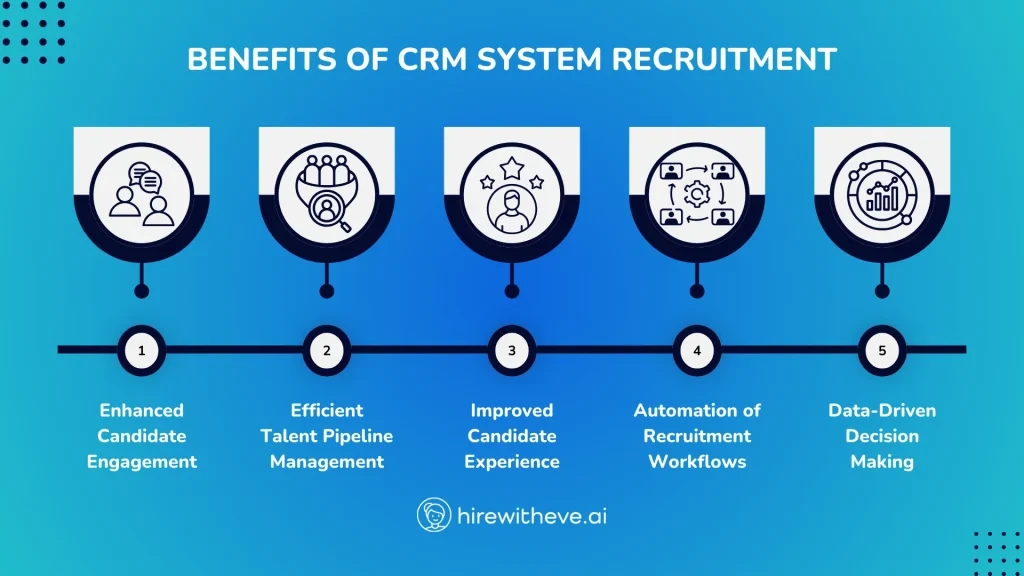
    Benefits of Using Recruitment CRM in HR Recruitment

    The adoption of recruitment CRM platforms delivers measurable advantages for HR teams and staffing agencies:

  • Improved Candidate Sourcing and Nurturing: Recruitment CRMs enable targeted outreach to passive candidates, maintaining engagement through personalized communication and automated workflows. This approach expands talent pools and reduces reliance on reactive hiring.
  • Faster Time-to-Hire and Reduced Candidate Drop-Off: Automation of repetitive tasks such as interview scheduling and follow-ups accelerates recruitment cycles. Data from industry reports indicate that organizations using recruitment CRMs experience up to 30% faster placements and significantly lower candidate attrition rates.
  • Enhanced Collaboration Among Recruitment Teams: Centralized candidate data and pipeline visualization improve transparency and alignment across recruiters, hiring managers, and HR leaders, minimizing miscommunication and duplication of effort.
  • Data-Driven Hiring Decisions with Analytics and Reporting: Recruitment CRMs offer comprehensive dashboards and metrics tracking, including source effectiveness, pipeline conversion rates, and candidate engagement scores. These insights enable continuous process optimization and strategic workforce planning.
  • Better Candidate Experience and Employer Branding: Consistent, timely communication and personalized engagement foster positive candidate perceptions, which are crucial in competitive talent markets. Recruitment CRMs support recruitment marketing initiatives that enhance employer brand visibility and reputation.
  • These benefits underscore recruitment CRM software as a strategic investment for organizations aiming to modernize their talent acquisition processes.

    Leading Recruitment CRM Solutions and Their Unique Capabilities

    Several recruitment CRM platforms dominate the market, each offering distinct features tailored to different organizational needs:

  • Recruiterflow: Combines ATS and CRM functionalities, providing recruiters with integrated pipeline management and multi-channel outreach tools. Recruiterflow’s automation capabilities include email sequencing and analytics to optimize candidate engagement.
  • Pipedrive: Known for its intuitive pipeline visualization and customizable workflows, Pipedrive serves as a centralized hiring hub enabling streamlined candidate tracking and automated task management. Its integration ecosystem supports connections with HRIS and productivity tools.
  • Zoho Recruit: Offers a customizable ATS and CRM hybrid focused on candidate retention. Zoho’s platform supports advanced sourcing, resume parsing, and AI-driven candidate matching, alongside extensive integrations and workflow automation.
  • iCIMS: An enterprise-grade recruitment CRM recognized for AI-powered candidate matching algorithms, comprehensive reporting, and seamless integration with HRIS, onboarding platforms, and job boards. iCIMS’ solution supports global recruitment teams with scalable pipelines and compliance features.
  • MokaHR: Features AI-driven sourcing and screening, with benchmarked improvements in candidate screening speed and accuracy. MokaHR’s platform emphasizes automation of repetitive tasks and real-time analytics to enhance recruiter productivity.
  • These options illustrate a spectrum of CRM capabilities, from SMB-focused solutions to enterprise-ready platforms, allowing organizations to select tools aligned with their scale and recruitment complexity.

    Integration and Automation: Enhancing Recruitment Efficiency

    Recruitment CRM platforms are increasingly designed to integrate seamlessly with other HR technology systems, amplifying their value:

  • ATS Synchronization: Integration with Applicant Tracking Systems ensures consistent candidate status updates, eliminating double data entry and improving transparency across recruitment stages.
  • HRIS and Onboarding Connectivity: Post-hire data flows from recruitment CRM to Human Resource Information Systems facilitate smooth onboarding, compliance tracking, and workforce analytics.
  • AI-Powered Resume Parsing and Candidate Matching: AI algorithms automatically extract candidate information from resumes and rank applicants based on job fit, significantly speeding up the screening process and enhancing sourcing precision.
  • Automation of Interview Scheduling, Follow-Ups, and Reporting: Automated workflows handle interview coordination, candidate reminders, and feedback collection, reducing administrative overhead and improving candidate experience.
  • By leveraging these integrations and automations, recruitment teams can focus on strategic activities such as candidate engagement and employer branding while maintaining operational efficiency.

    Practical Use Cases and Success Stories

    Real-world applications of recruitment CRM demonstrate the transformative impact on hiring outcomes:

  • Mercy Health’s CRM implementation: By deploying iCIMS recruitment CRM, Mercy Health cut its time-to-hire from over 20 days to 11 days, driven by automated candidate outreach and pipeline visibility. The system’s AI matching capabilities also improved candidate-job fit, reducing early turnover.
  • Staffing Agencies’ Productivity Gains: Agencies utilizing customized pipelines and automation within platforms like Recruiterflow report up to 40% increases in recruiter productivity. Automated multi-channel outreach campaigns maintain candidate engagement, leading to higher placement rates.
  • Candidate Retention and Repeat Business: Recruitment CRMs enable staffing firms to nurture long-term relationships with candidates, improving repeat placement opportunities and building a sustainable talent network that differentiates them competitively.
  • These cases exemplify how recruitment CRM platforms contribute to operational excellence and strategic talent acquisition.

    Choosing the Right Recruitment CRM for Your HR Team

    Selecting an appropriate recruitment CRM involves evaluating multiple factors:

  • Scalability and Customization: Organizations should assess whether the CRM supports growth and can be tailored to unique workflows, including pipeline stages, communication templates, and reporting needs.
  • Integration Capabilities: Compatibility with existing ATS, HRIS, job boards, and productivity tools ensures seamless data flow and minimizes disruption during adoption.
  • Pricing and User Experience: CRM platforms vary widely in cost structure; free trials and user reviews on platforms like G2 provide insights into usability, customer support, and ROI.
  • Future Trends Consideration: Emerging features such as AI-driven candidate engagement, omnichannel communication, and enhanced recruitment analytics should inform long-term investment decisions.
  • By conducting thorough evaluations and leveraging user feedback, HR teams can select recruitment CRM software that aligns with their strategic hiring goals.

    FAQ

    What is the difference between a recruitment CRM and an ATS?

    A recruitment CRM focuses on managing long-term candidate relationships, nurturing talent pipelines, and automating outreach, whereas an ATS primarily handles the administrative aspects of processing job applications and tracking candidates through active job openings.

    How does recruitment CRM improve candidate experience?

    Recruitment CRM automates personalized communication, timely follow-ups, and multi-channel engagement, ensuring candidates receive consistent updates and feel valued throughout the hiring process, which enhances their overall experience.

    Can recruitment CRM integrate with existing HR systems?

    Yes, most modern recruitment CRMs offer integrations with ATS, HRIS, job boards, and onboarding platforms, enabling seamless data synchronization and workflow automation across HR functions.

    What role does AI play in recruitment CRM?

    AI enhances recruitment CRM by automating resume parsing, improving candidate-job matching accuracy, predicting candidate engagement, and optimizing outreach timing, which increases sourcing efficiency and hiring quality.

    Which recruitment CRM is best for staffing agencies?

    Platforms like Recruiterflow and Zoho Recruit are popular among staffing agencies due to their strong multi-channel outreach, customizable pipelines, and automation features tailored to agency workflows. However, the best choice depends on specific agency size, budget, and integration needs.

    Recruitment CRM software will continue to evolve with advancements in AI and automation, driving more personalized candidate engagement and data-driven hiring decisions. HR teams should prioritize solutions that offer seamless integration, scalability, and adaptability to future recruitment trends to maintain competitive advantage and optimize talent acquisition strategies.

    For further detailed comparisons and platform reviews, explore these resources: top recruitment CRM software and best recruitment CRM platforms.

    Advertisement

    [the_ad_group id="903"]