Advertisement
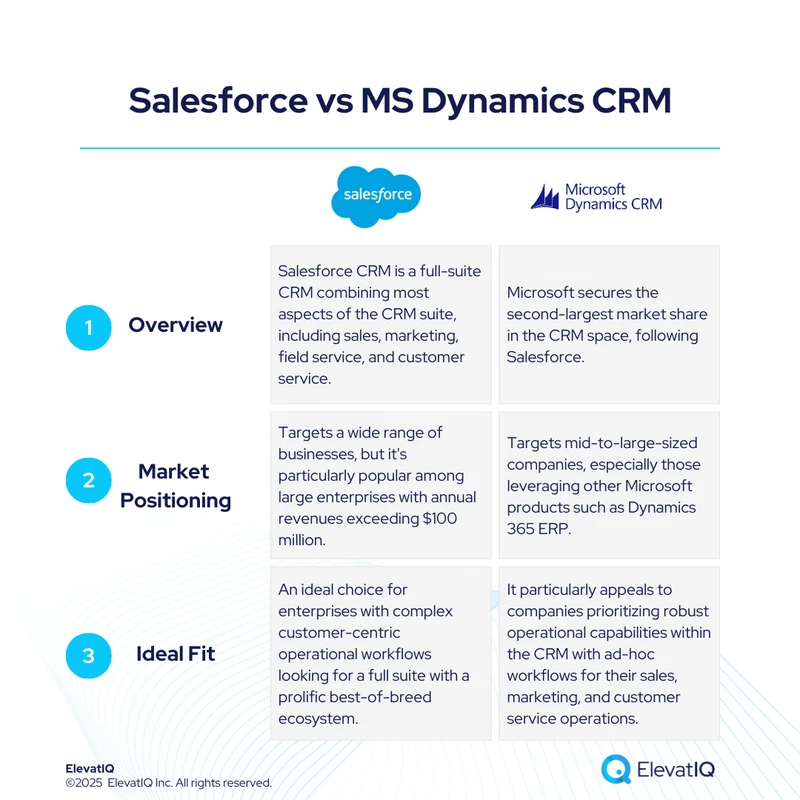
CRM Software – Microsoft Dynamics 365 and Salesforce stand as two dominant CRM platforms shaping enterprise customer relationship management. Both offer robust core CRM functionalities—sales automation, customer service, marketing tools, and analytics—but diverge significantly in integration ecosystems, customization capabilities, deployment flexibility, and pricing models. Understanding these differences is crucial for businesses aiming to align their CRM choice with existing technology stacks and long-term strategic goals.
Dynamics 365 excels in delivering seamless integration across the Microsoft ecosystem, connecting natively to Microsoft 365 applications such as Outlook, Teams, SharePoint, and leveraging Azure’s cloud infrastructure and AI services. In contrast, Salesforce commands a vast third-party app marketplace, Salesforce AppExchange, and a highly customizable platform architecture tailored for cloud-first deployments. This foundational contrast influences not just technical integration but also deployment options, user experience, and total cost of ownership.
Integration Ecosystems and Deployment Models
Microsoft Dynamics 365’s integration capabilities center on deep native connections with Microsoft 365 productivity tools and Azure cloud services. Users benefit from real-time data synchronization with Outlook for email tracking, Teams for collaboration, and SharePoint for document management. Additionally, integration with Power BI delivers advanced business intelligence dashboards embedded directly into CRM workflows. These integrations reduce onboarding friction for organizations already entrenched in Microsoft environments, promoting user adoption and operational efficiency.
Advertisement
Dynamics 365 supports versatile deployment models—cloud, on-premises, or hybrid—offering organizations control over data residency and infrastructure preferences. This flexibility is particularly advantageous for industries with strict compliance requirements or those transitioning gradually to cloud architectures. The Azure platform further enhances scalability and security for cloud deployments.
Conversely, Salesforce operates exclusively as a cloud-based SaaS platform, prioritizing agility and scalability without on-premises options. Its API-first design supports extensive integration with thousands of third-party applications via Salesforce AppExchange, enabling tailored extensions across sales, marketing, and service functions. The platform’s integration flexibility facilitates complex workflows but may require additional middleware or custom development to bridge with legacy systems, especially in hybrid IT environments.
The deployment choice between Dynamics’ multi-modal approach and Salesforce’s cloud-only model reflects organizational priorities around data control, compliance, and IT infrastructure modernization strategies.
Customization and Extensibility
Salesforce’s customization capabilities are widely regarded as industry-leading due to its flexible metadata-driven architecture and the expansive AppExchange ecosystem. Organizations can leverage pre-built applications or develop custom modules using Salesforce’s proprietary programming language, Apex, and Lightning Web Components. This allows granular tailoring of CRM processes, UI, and automation workflows to fit diverse business models and vertical requirements.
Microsoft Dynamics 365 leverages the Power Platform—comprising Power Apps, Power Automate, and Power BI—to enable customization and workflow automation. Power Apps offer low-code/no-code development environments, empowering citizen developers to create bespoke applications integrated tightly with Dynamics data. Power Automate extends this by enabling automated workflows across Microsoft and third-party services, enhancing process efficiency without heavy coding. While powerful, Dynamics customization often requires expertise in both CRM configuration and Power Platform tools, which can increase implementation complexity.
Implementation case studies, such as AscendixRE’s adoption of Dynamics 365, illustrate that organizations with existing Microsoft expertise experience smoother customization and faster onboarding. However, the learning curve can be steeper for users unfamiliar with Microsoft’s ecosystem compared to Salesforce’s modern, intuitive customization tools.
AI and Analytics Capabilities
Both platforms embed AI-driven analytics to enhance sales forecasting, customer insights, and service optimization, but their approaches reflect their respective ecosystems.
Dynamics 365 integrates Microsoft Copilot and Azure AI services to provide contextual suggestions, predictive analytics, and natural language processing within the CRM interface. These AI capabilities are bolstered by Power BI’s data visualization strengths, enabling users to generate actionable insights across sales pipelines and customer interactions. The integration with Microsoft’s broader AI infrastructure supports advanced scenarios such as relationship analytics and intelligent automation.
Salesforce Einstein AI offers embedded AI functionalities tailored for CRM-specific use cases, including lead scoring, opportunity insights, and automated case classification. Einstein’s predictive models analyze historical data to forecast customer behavior and sales trends. The tight integration with Salesforce’s cloud platform and its AppExchange ecosystem allows rapid deployment of AI-powered apps and analytics extensions.
Both platforms’ AI tools contribute to enhancing user productivity and data-driven decision-making, though Dynamics’ AI benefits from the broader Azure AI service integration, while Salesforce emphasizes out-of-the-box predictive analytics optimized for CRM workflows.
Pricing Models and Total Cost of Ownership
Dynamics 365 adopts a modular pricing structure, allowing businesses to purchase individual applications (Sales, Customer Service, Marketing) or bundled packages. Microsoft often offers discounted pricing for organizations already licensed for Microsoft 365, presenting cost efficiencies in integrated environments. Licensing tiers vary based on feature sets and user roles, with add-ons for advanced AI and analytics.
Salesforce pricing is subscription-based and generally cloud-only, with editions segmented by feature richness and user capacity. While competitive, Salesforce pricing can escalate due to mandatory add-ons for advanced capabilities or third-party integrations. The overall cost of ownership also includes training and customization expenses, which can be significant given Salesforce’s extensive customization potential.
For small to medium enterprises, Dynamics 365’s bundled discounts and deployment flexibility may present a more cost-effective option, while large enterprises seeking extensive customization might accept higher Salesforce licensing costs for its scalability and ecosystem benefits.
User Experience and Training
Salesforce is noted for its modern, intuitive user interface designed for ease of use, with continual enhancements driven by user feedback. The Trailhead learning platform supports comprehensive user training and certification, fostering adoption through gamified, self-paced education. This reduces training overhead and accelerates proficiency.
Dynamics 365’s user experience aligns with Microsoft’s Windows and Office design language, which benefits users familiar with Microsoft products but may pose challenges for new users due to a steeper learning curve. Organizations entrenched in Microsoft tools find onboarding more straightforward, leveraging existing user skills. However, the complexity of Dynamics’ modular design and customization options often requires dedicated training programs and change management to achieve effective adoption.
Real-world implementations highlight that user experience and training investments significantly impact CRM success, underscoring the importance of aligning platform choice with organizational culture and user capabilities.
Partner Ecosystem and Marketplace
Salesforce boasts a large global partner network and AppExchange marketplace, offering thousands of third-party applications, integrations, and consulting services. This extensive ecosystem supports rapid innovation and industry-specific solutions, enabling organizations to tailor CRM capabilities extensively.
Microsoft’s ISV marketplace is growing rapidly, fueled by the Power Platform and Azure integrations. The Microsoft partner network provides robust support, particularly for enterprises leveraging the broader Microsoft technology stack. While smaller than Salesforce’s AppExchange, Microsoft’s marketplace benefits from cross-product synergies and enterprise-grade support.
The choice between these ecosystems often depends on an organization’s preference for vendor alignment—Salesforce for diverse third-party innovation or Microsoft for integrated enterprise support.
Use Case Scenarios and Decision-Making Criteria
Microsoft Dynamics 365 is optimal for organizations deeply invested in Microsoft technologies, requiring ERP integration, or needing flexible deployment options including on-premises or hybrid cloud. Industries with strict regulatory compliance or data residency mandates often find Dynamics’ deployment flexibility advantageous. Its native integration with Microsoft 365 tools enhances productivity for teams already using Outlook, Teams, and SharePoint.
Salesforce is better suited for businesses prioritizing extensive customization, rapid cloud scaling, and access to a broad third-party application ecosystem. Companies seeking a cloud-first CRM with advanced AI-driven sales forecasting and a modern user experience benefit from Salesforce’s architecture and Trailhead learning resources.
Decision-makers should assess existing IT infrastructure, customization needs, compliance requirements, and total cost of ownership to identify which platform aligns with their strategic CRM vision.
FAQ
What are the main integration differences between Microsoft Dynamics 365 and Salesforce?
Microsoft Dynamics 365 integrates natively with the Microsoft 365 suite (Outlook, Teams, SharePoint) and Azure cloud services, supporting cloud, hybrid, and on-premises deployments. Salesforce offers a cloud-only model with extensive third-party integrations via AppExchange and flexible API capabilities, requiring middleware for legacy system connections.
How do customization options compare between Dynamics 365 and Salesforce?
Salesforce provides deep customization through its Apex programming language and a vast AppExchange marketplace. Dynamics 365 customization relies on the Power Platform’s low-code tools like Power Apps and Power Automate, enabling integration with Microsoft services but often demanding more technical expertise for complex workflows.
Which CRM offers better AI-driven analytics?
Both platforms provide advanced AI analytics; Dynamics 365 utilizes Microsoft Copilot and Azure AI, with strong integration into Power BI dashboards. Salesforce Einstein AI specializes in CRM-specific predictive analytics such as lead scoring and opportunity forecasting. The choice depends on whether organizations prefer broader AI infrastructure (Dynamics) or CRM-focused AI tools (Salesforce).
What deployment options are available for these CRM platforms?
Dynamics 365 supports cloud, on-premises, and hybrid deployments, catering to diverse compliance and infrastructure needs. Salesforce operates exclusively as a cloud-based SaaS platform, focusing on scalability and rapid deployment without on-premises options.
How do pricing models differ between Microsoft Dynamics 365 and Salesforce?
Dynamics 365 offers modular pricing with bundled discounts for Microsoft 365 users, allowing tailored purchase of CRM applications. Salesforce uses subscription-based pricing with tiered editions and additional costs for advanced features or integrations. Dynamics may be more cost-effective for Microsoft-centric businesses, while Salesforce pricing escalates with customization.
Microsoft Dynamics 365 and Salesforce represent mature CRM ecosystems with distinct strengths shaped by their integration focus, customization paradigms, and deployment models. Organizations embedded within the Microsoft ecosystem benefit from Dynamics’ native integration, hybrid deployment flexibility, and bundled pricing advantages. Meanwhile, Salesforce appeals to businesses seeking unparalleled customization, a vast third-party application marketplace, and a cloud-first operational model. Navigating this choice involves assessing technology alignment, compliance requirements, user experience preferences, and long-term CRM strategy to ensure the selected platform maximizes business value and scalability.
For further expert analysis, see the detailed comparison at Itransition’s Microsoft Dynamics vs Salesforce overview and insights from Rand Group’s Dynamics 365 and Salesforce CRM analysis.
Advertisement